Taxi and private hire fleets deal with a specific set of dash cam risks — passenger disputes, licensing conditions, and insurers who punish unverified claims — and picking the wrong system means paying for hardware that can't do the one job it was bought for.
- Dual-facing 4G dash cams are the best dash cam systems for taxi fleets in 2026 — buy for passenger disputes and licensing.
- 360-degree vehicle CCTV suits black cabs and high-volume ranks; single-channel forward-only units are a false economy for taxis.
- AI driver behaviour add-ons cut premiums once base cameras are live — hold until footage quality is proven.
- Consumer-grade DIY dash cams skip the fleet features taxi licensing conditions increasingly require. Skip.
- Thatcham S7 trackers start at £198 and pair well with dash cams for full theft and dispute cover.
Why this matters
Taxi and private hire drivers face more passenger disputes, more contested injury claims, and more scrutiny from licensing officers than almost any other commercial vehicle operator. A dash cam that only films the road settles half an argument and loses the other half.
Crystal Ball builds dash cam systems around that exact problem: footage that holds up in a licensing hearing, an insurance claim, or a customer complaint, not just a memory card that might have caught something. For a deeper look at the sector-specific hardware, see the guide to 4G dash cams for taxi and private hire fleets.
Get the wrong dash cam system for taxi fleets in 2026 and you're not saving money — you're buying a camera that can't answer the question it was installed to answer.
“A dash cam that only films the road settles half an argument and loses the other half.”
How we ranked
Every system below is judged against four things a taxi or PHV fleet manager actually needs: footage that captures the road and the cabin, connectivity that gets footage off the vehicle before anyone can delete it, compatibility with local licensing conditions, and total cost once installation and monitoring are counted.
Systems that only clear one of those boxes get marked Hold or Skip, even when they're the cheapest option on the shelf. Systems that clear all four earn a Buy. Pricing below reflects hardware and, where stated, installation — check the current pricing on the site before ordering, since vehicle count and vehicle type move the final quote.
The ranked list
1. Dual-facing 4G dash cams — the standard-bearer
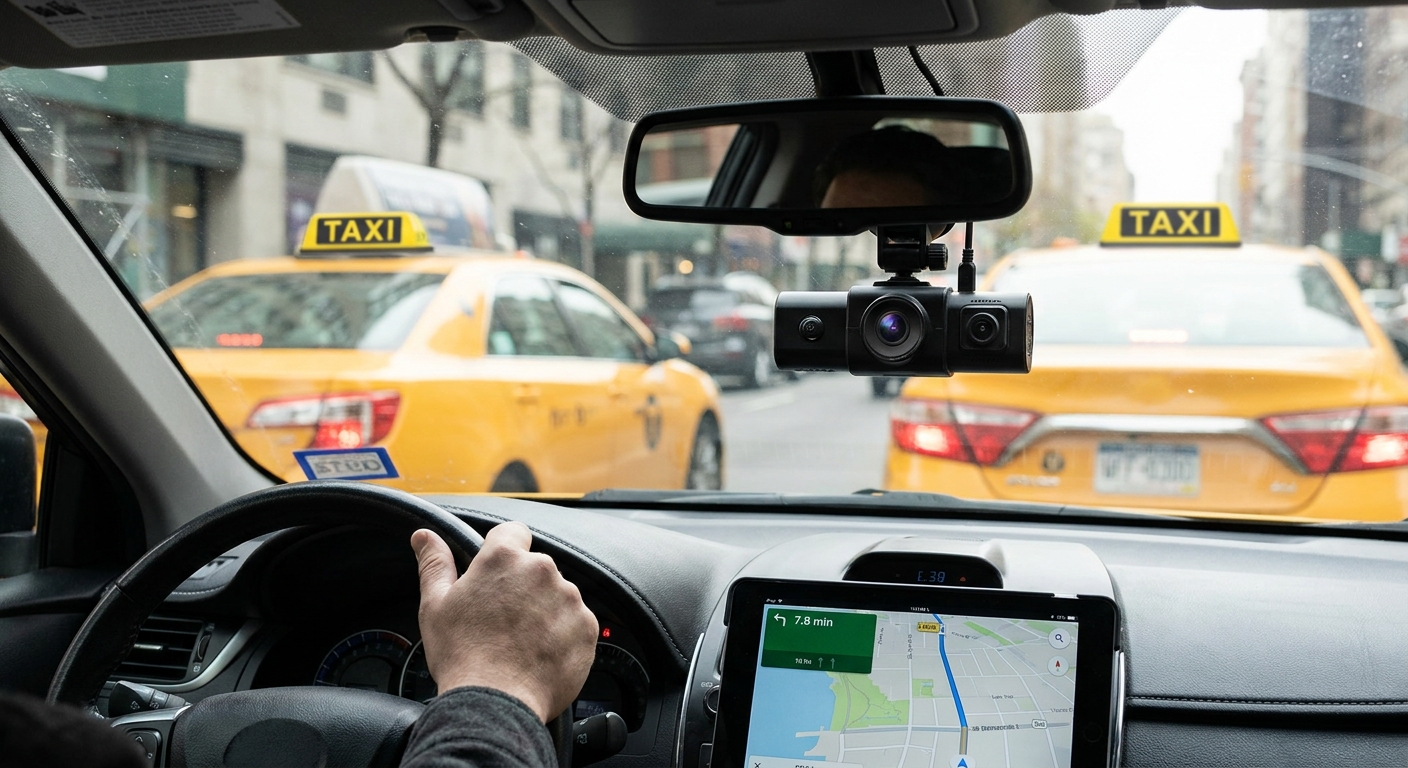
Crystal Ball's 4G Fleet Dash Cam records the road and the cabin at the same time, over a live 4G link instead of an SD card someone can pull before you ever see it.
For a taxi fleet, that dual view is the difference between an unresolved argument and a settled file. A driver accused of an unsafe pickup, or a passenger alleging something that didn't happen, gets answered by footage instead of a week of back-and-forth.
The 4G connection matters more than the lens count — SD-card-only systems still need someone to physically retrieve the card, and by the time that happens it's often full, corrupted, or missing.
Buy — this is the baseline spec for any taxi or PHV vehicle running in 2026, not an upgrade.
2. 360-degree vehicle CCTV — the black cab specialist
Crystal Ball's 360° Vehicle CCTV covers the full perimeter of the vehicle, not just the forward and cabin views a standard two-lens unit gives you.
Wheelchair-accessible vehicles, minibuses running as PHVs, and high-volume rank operators deal with boarding disputes, kerbside knocks, and reversing incidents a dual-facing camera never sees. Full coverage removes the argument about what happened outside the doors.
It costs more to fit and takes longer to roll out across a mixed fleet than a standard dual-facing camera.
Buy for larger vehicles or high passenger turnover; overkill for a two-car minicab operation.
3. AI driver behaviour add-ons — the insurance play
Crystal Ball's Driver Behaviour module layers harsh-braking, speeding, and cornering data on top of footage the dash cam already records.
Insurers increasingly ask for behaviour data before holding premiums flat on taxi fleets, given the annual mileage a licensed vehicle racks up compared with an average van. The module turns raw footage into a coaching script instead of just an evidence archive.
It only earns its cost once the base camera system is live and generating consistent footage across the fleet.
Hold until the core dash cam rollout is finished, then layer it on.
4. Single-channel forward-only dash cams — the false economy
These units record the road and nothing else, usually at a lower unit cost than a dual-facing 4G system.
They miss every dispute that starts inside the vehicle, which for a taxi fleet is most of them. A false claim about driver conduct or a fare argument goes unanswered because the only footage is the windscreen view.
Hold if budget is genuinely the only constraint, and plan to upgrade at licensing renewal.
5. Consumer-grade DIY dash cams — the DIY trap
General retail dash cams built for private cars lack live 4G upload, fleet-wide management, and any real tamper-resistance.
A driver can pull the SD card, angle the lens away from the cabin, or claim the unit "wasn't recording" — none of which happens with a monitored 4G fleet system. Licensing authorities that require working CCTV as a condition of an operator's licence generally don't accept a phone-mount dash cam as compliant.
Skip — it looks like a saving and turns into a licensing and liability problem.
6. Cloud-connected fleet dash cam platforms — the scale-up choice
Once a taxi fleet passes a handful of vehicles, dash cam footage needs to live inside the same platform as vehicle tracking, driver ID, and maintenance records — not a separate login per system. The guide to fleet management software for small businesses covers what that integration should include.
Running dash cams, tracking, and compliance data through one dashboard cuts a footage request from three logins down to one.
Buy once you're managing more than a handful of vehicles or more than one depot.


Comparison table
| System type | Best for | Connectivity | Verdict |
|---|---|---|---|
| Dual-facing 4G dash cam | Any taxi/PHV vehicle | Live 4G | Buy |
| 360-degree vehicle CCTV | Black cabs, high-volume ranks | Live 4G | Buy |
| AI driver behaviour add-on | Fleets already live on dash cams | Data layer on existing 4G link | Hold |
| Single-channel forward-only | Budget-constrained fleets | SD card or 4G | Hold |
| Consumer-grade DIY dash cam | Nobody running a licensed fleet | None or local storage only | Skip |
| Cloud-connected fleet platform | Fleets past a handful of vehicles | 4G plus fleet management software | Buy |
Where to buy
- Confirm Thatcham approval before signing anything — the guide to Thatcham-approved trackers for high-value fleet vehicles covers what that rating means, and the same insurers who ask for it on trackers ask for verified footage retention on dash cams.
- Ask what the monitoring centre actually covers — Crystal Ball runs its centre 24/7/365, which matters when an incident happens on a Saturday night shift and not during office hours.
- Check installation lead time against your licence renewal date. Next-day fitting slots exist on tracker hardware for orders placed before 1pm, and any dash cam installer should give you a firm date, not "sometime this month."
FAQ
What's the best dash cam system for a taxi fleet in 2026?
A dual-facing 4G dash cam is the best dash cam system for taxi fleets in 2026, since it records the road and the cabin over a live connection instead of a removable SD card. Crystal Ball's 4G Fleet Dash Cam covers both angles as standard.
Is a 4G dash cam better than an SD card dash cam for taxis?
Yes, a 4G dash cam is better because footage uploads off the vehicle automatically instead of sitting on a card a driver can remove or overwrite. SD-only systems only help once someone physically retrieves the card, which is often too late.
Do taxi licensing authorities require dash cams?
Several UK licensing authorities now require working CCTV or dash cam footage as a condition of an operator's licence. Requirements vary by council, so check the exact wording of your local licensing conditions before choosing hardware.
How much does a fleet dash cam system cost in the UK?
Cost depends on the number of vehicles, the number of camera angles, and whether you add tracking or driver behaviour modules. Check current pricing directly, since taxi fleet quotes vary with vehicle type and fleet size.
Can one dash cam cover both driver disputes and passenger disputes?
A dual-facing dash cam covers both, since it films the road ahead for driving disputes and the cabin for passenger disputes at the same time. A single forward-facing camera only resolves the road-facing half of any argument.
Is 360-degree CCTV worth it for a minicab fleet?
It's worth it for larger vehicles, wheelchair-accessible vehicles, and high-volume rank operators dealing with boarding or kerbside incidents. A small two-car minicab operation usually doesn't need full perimeter coverage.
Do I need a Thatcham tracker as well as a dash cam?
A Thatcham tracker and a dash cam solve different problems — theft recovery versus dispute evidence — and running both together is common on higher-value taxi and PHV vehicles. Thatcham S7 trackers start at £198, well below the cost of losing a vehicle outright.
How long does dash cam footage need to be retained?
Retention periods vary by licensing authority and insurer, so confirm the exact figure with whoever is setting your operating conditions. Cloud-connected 4G systems make it easier to retrieve and retain footage beyond whatever a local SD card would allow.
One last thing
Most taxi vehicles run two or three drivers across different shifts, and a dash cam alone doesn't tell you which one was behind the wheel when a dispute happened. Pairing the camera with Driver ID closes that gap — footage shows the incident, Driver ID shows exactly who was driving when it occurred, which matters the moment a licensing officer or insurer asks the follow-up question.