Congestion charge fleet management in 2026 comes down to one question: does the software stop a charge before it happens, or just tell you about it after the invoice lands. This guide ranks the capabilities that actually matter for London Congestion Charge, ULEZ, and council Clean Air Zone exposure, and names where the gaps usually are.
- Live geofencing that flags a zone entry in real time is the non-negotiable for congestion charge fleet management - buy on this criterion first.
- Crystal Ball's Direct Vision Standard package (£599 fitted, 2026 pricing) covers HGV compliance for London zones - verdict: Buy for HGV operators running into the capital.
- Route planning that reroutes around Congestion Charge and ULEZ boundaries cuts avoidable charges without adding mileage.
- Skip any tool that only reconciles TfL invoices after the fact - it can't stop a charge before it lands.
Why this matters
Congestion charge zones - the London Congestion Charge, ULEZ, and the growing list of local authority Clean Air Zones - charge per vehicle, per entry, per day. A fleet that can't see which vehicles crossed a boundary and when pays the charge blind, every time it happens. That's the gap congestion charge fleet management software is built to close.
Crystal Ball's fleet management platform sits on top of the same GPS hardware used for theft recovery and driver monitoring, so the zone-crossing data already exists - the question is whether the software surfaces it before the invoice arrives, not after. For SMEs running two or three vans into London and councils running mixed fleets of 50-plus vehicles, that timing difference is the whole point of the software.
How we ranked
This ranking weighs four things: whether the capability stops a charge before it's incurred rather than after, how much manual admin it removes from a fleet manager's week, whether it works for both SME van fleets and council fleets without separate licences, and whether the cost is proportionate to the risk it removes.
Capabilities that only report on charges already paid rank lowest, because by definition they can't prevent anything. Capabilities tied to hardware that's already Thatcham-approved or DVS-compliant rank highest, because they solve congestion charge management and an insurance or compliance requirement at the same time. Pricing referenced below reflects Crystal Ball's own published 2026 pricing where a like-for-like external benchmark isn't available.
1. Live geofencing on charge zone boundaries - the non-negotiable
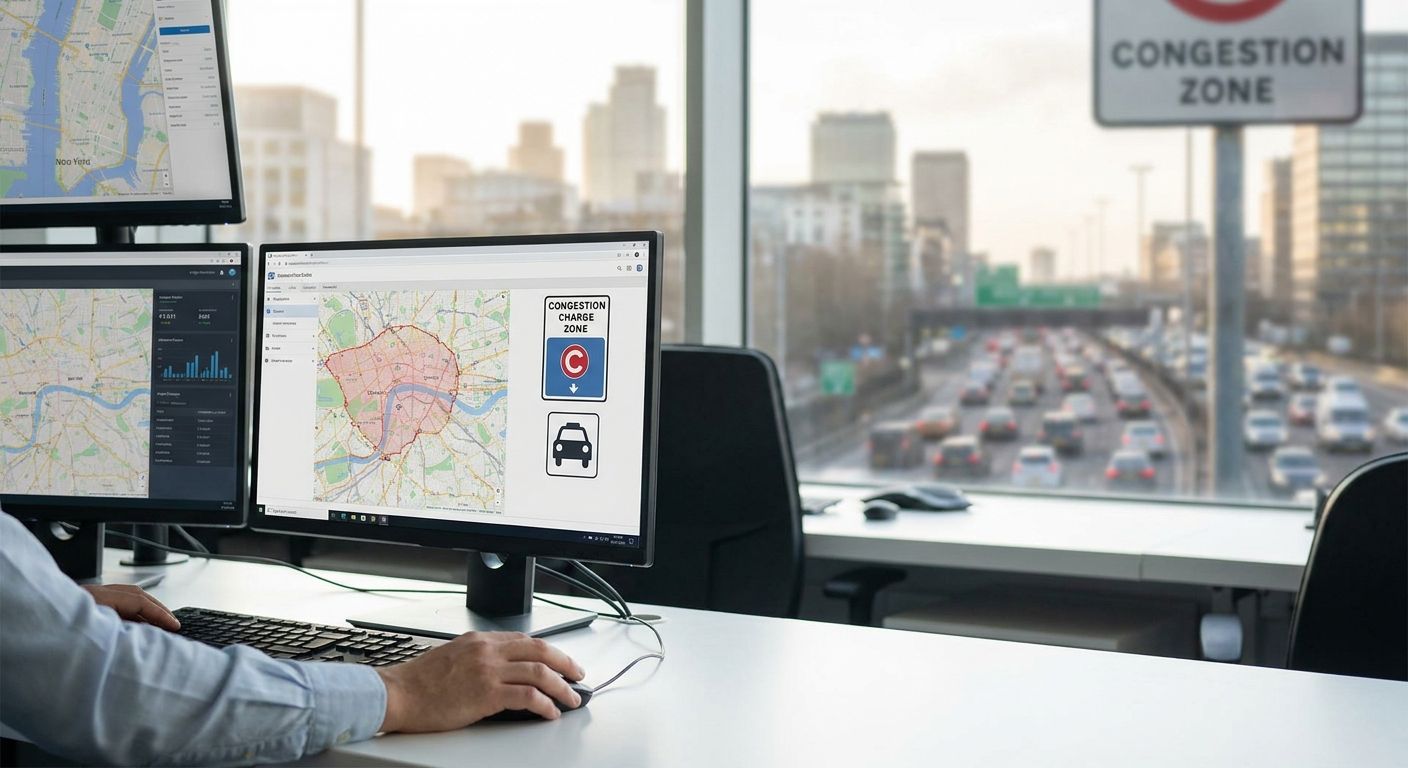
This is the baseline requirement, not a nice-to-have. Geofencing draws a digital boundary around the Congestion Charge zone, ULEZ, or a council's Clean Air Zone and fires an alert the moment a tracked vehicle crosses it - not the next morning when the fleet manager checks a report.
For local authority fleets running dozens of vehicles across a mixed geography, fleet tracking software built for local government fleets applies this at scale, flagging every zone entry against a vehicle list rather than relying on a driver to remember the boundary. Verdict: Buy - nothing else on this list works without it.
2. HGV-specific compliance: Direct Vision Standard - the one HGV operators skip and regret
HGVs over 12 tonnes need a Direct Vision Standard star rating and camera/sensor monitoring to operate legally in Greater London, and that requirement sits on top of any congestion charge. Crystal Ball's Direct Vision Standard package runs at £599 fitted in 2026 and pairs the compliance camera system with the same tracking platform used for zone alerts.
Operators running HGVs into London daily save the admin of managing two separate systems - one for DVS, one for charge-zone tracking - by running both through the HGV operator licence compliance requirements framework instead. Verdict: Buy if any HGV in the fleet enters Greater London more than once a week.
3. Route planning that reroutes around zone boundaries - the fuel saver in disguise
Route planning software that treats a charge zone boundary as a routing constraint - not just a line on a map - reroutes low-priority jobs around it automatically. That only works if the mapping engine updates zone boundaries as they change, which councils and TfL do periodically.
This is a Consider, not an automatic Buy, because the saving only materialises on routes where a detour genuinely costs less in time and fuel than the charge itself. On an occasional zone crossing that math is marginal; on a fleet doing it 20 times a week across multiple vans, it adds up fast. Verdict: Consider for fleets running five or more zone crossings a week.
4. Cost reporting dashboards split by charge type - the finance director's favourite
A fleet manager who can't separate congestion charge costs from fuel, tolls, and parking in one report is flying blind on where the actual spend goes. Reporting dashboards that tag charge-zone costs separately show, per vehicle and per month, exactly how much a specific route or driver is costing in avoidable zone fees.
This matters most for calculating whether new software pays for itself - the same logic used to calculate ROI on fleet management software applies directly to congestion charge costs, since the charge line is one of the easiest to isolate and cut. Verdict: Buy for any fleet running more than 10 vehicles.
5. Driver behaviour scoring tied to zone entries - nice-to-have, not essential
Driver behaviour monitoring flags harsh braking and speeding, but a version that also flags avoidable zone entries - a driver taking the direct route through a charge zone instead of the pre-set detour - turns a safety tool into a cost-control one. It's a genuine upgrade over basic geofencing, not a replacement for it.
Verdict: Consider as an add-on once geofencing and route planning are already in place, not as a first purchase.
6. Back-office charge reconciliation only, no live tracking - the trap
Some software only reconciles TfL invoices after they land, matching each charge to a vehicle and driver after the fact. That's an admin convenience, not congestion charge fleet management - it tells a fleet manager what already happened, not what's about to happen.
Verdict: Skip as a standalone tool. Use it only as a bolt-on to a system that already has live geofencing, never as the core of a congestion charge strategy.


Comparison table
| Capability | Prevents charges before they happen | Works for SMEs | Works for council fleets | Verdict |
|---|---|---|---|---|
| Live geofencing | Yes | Yes | Yes | Buy |
| DVS compliance (HGV) | Yes | Yes (HGV only) | Yes | Buy for HGV |
| Route planning around zones | Partial | Yes | Yes | Consider |
| Cost reporting dashboards | No - reports after | Yes | Yes | Buy |
| Driver behaviour scoring | Partial | Yes | Yes | Consider |
| Invoice reconciliation only | No | Yes | Yes | Skip |
Where to buy
Buy from a supplier whose tracking hardware carries Thatcham accreditation - S5 and S7 ratings both qualify for insurance discounts, and Crystal Ball's range runs from £198 for the S7 up to £548 for the S5 Plus, with the standard S5 sitting at £374. A Thatcham badge on the box means an underwriter will actually recognise it.
Check that the monitoring centre behind the tracker runs 24/7/365, not office hours only - a zone-crossing alert that arrives Monday morning after a weekend of charges isn't congestion charge fleet management, it's a bill.
Ask for nationwide, on-site installation before signing anything. A tracker that arrives in a box for self-fitting is one of the biggest reasons geofencing alerts don't work in practice.
FAQ
What's the best fleet software for congestion charge management in 2026?
The best fleet software for congestion charge management in 2026 combines live GPS geofencing on zone boundaries with HGV compliance tracking, so a fleet manager sees a zone crossing the moment it happens rather than on a TfL invoice weeks later. Crystal Ball's fleet management platform pairs this with Thatcham-approved trackers starting at £198.
Does GPS tracking actually reduce congestion charge costs?
GPS tracking itself doesn't reduce the charge, but the geofence alerts it generates let a fleet manager reroute or flag a vehicle before a repeat daily charge accrues. The saving comes from catching avoidable repeat entries, not from the hardware itself.
Is congestion charge management different for HGVs than vans and cars?
Yes - HGVs over 12 tonnes need Direct Vision Standard compliance on top of any congestion charge, while vans and cars only need zone-entry tracking. Crystal Ball's Direct Vision Standard package covers the HGV-specific camera and sensor requirement at £599 fitted in 2026.
How much does a Thatcham-approved tracker cost in 2026?
Thatcham-approved trackers in the Crystal Ball range cost from £198 for an S7-rated unit up to £548 for an S5 Plus, with the standard S5 priced at £374 in 2026. The rating affects the insurance discount a fleet can claim, not just the tracking features.
Can fleet software submit congestion charge exemption applications automatically?
Fleet software can flag which vehicles are likely eligible for an exemption or discount based on tracked vehicle data, but the exemption application itself still goes through the relevant authority, such as TfL, directly. No software replaces that submission step in 2026.
What's the difference between ULEZ and Congestion Charge software requirements?
ULEZ charges are based on a vehicle's emissions standard, while the Congestion Charge is based on when and where a vehicle travels regardless of emissions. Software needs to track both a vehicle's emissions category and its zone entries to manage both charges correctly.
Do council fleets need different congestion charge management tools than SMEs?
Council fleets typically need the same geofencing core as SME fleets, but at a larger scale across mixed vehicle types and multiple sites, which is why local-government-specific fleet tracking software exists separately from small-business packages.
How much does Direct Vision Standard compliance cost?
Direct Vision Standard compliance through Crystal Ball costs £599 fitted in 2026, covering the required camera and sensor system for HGVs operating in Greater London.
One last thing
Most fleets that think their geofencing has failed haven't had a software problem - they've had a boundary problem. Charge zone boundaries get redrawn periodically, and a geofence built on last year's map polygon quietly stops covering a side street that's now inside the zone. Before blaming the software for a missed alert in 2026, check the boundary date on the geofence itself - that's a five-minute fix that catches more missed charges than switching providers ever does.