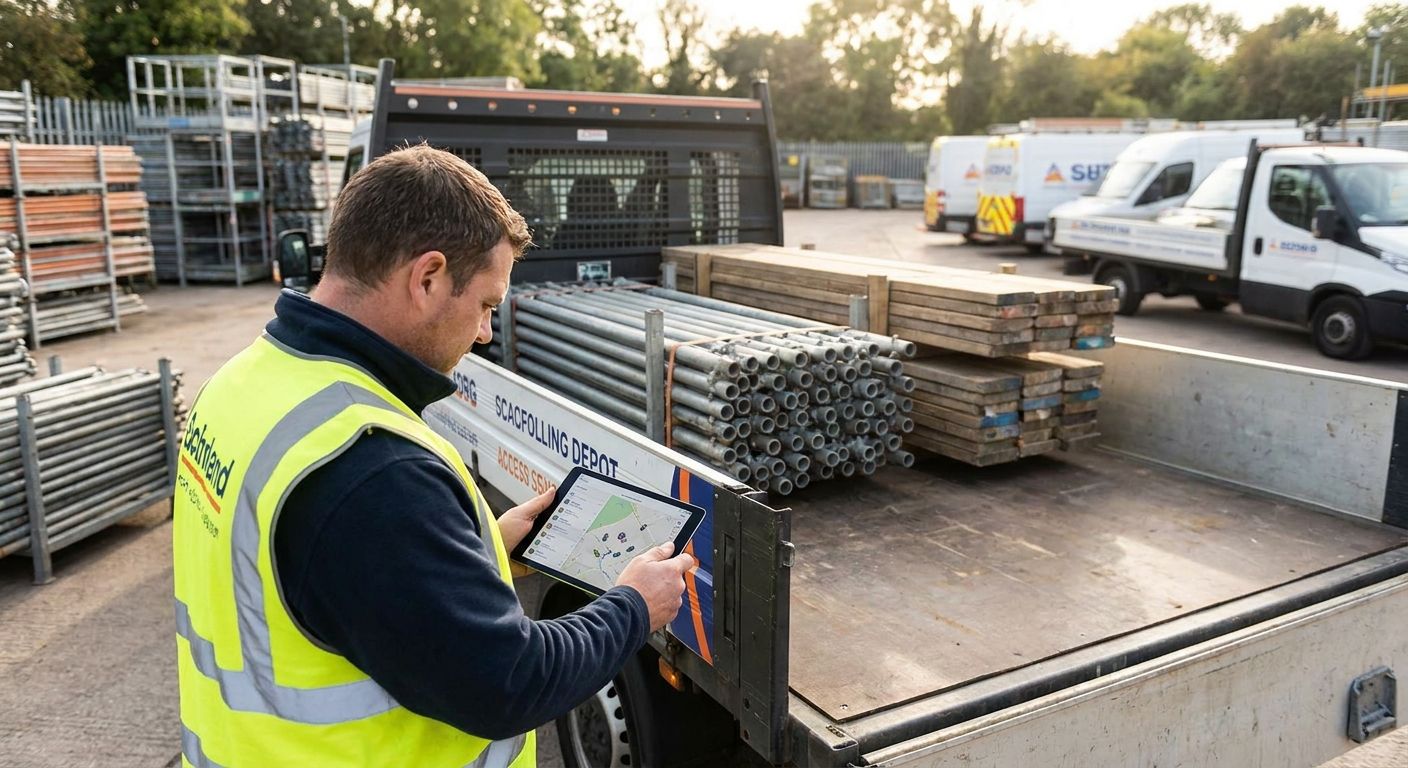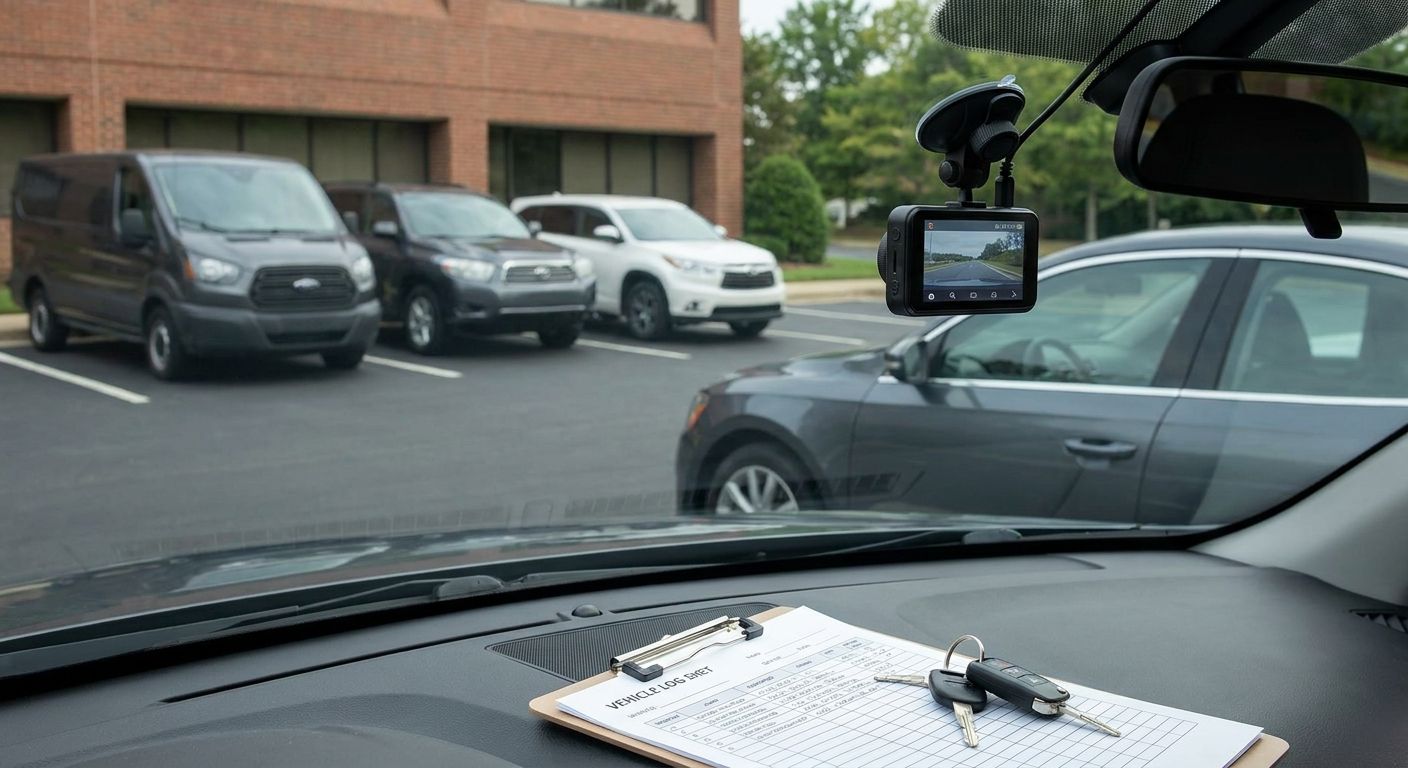
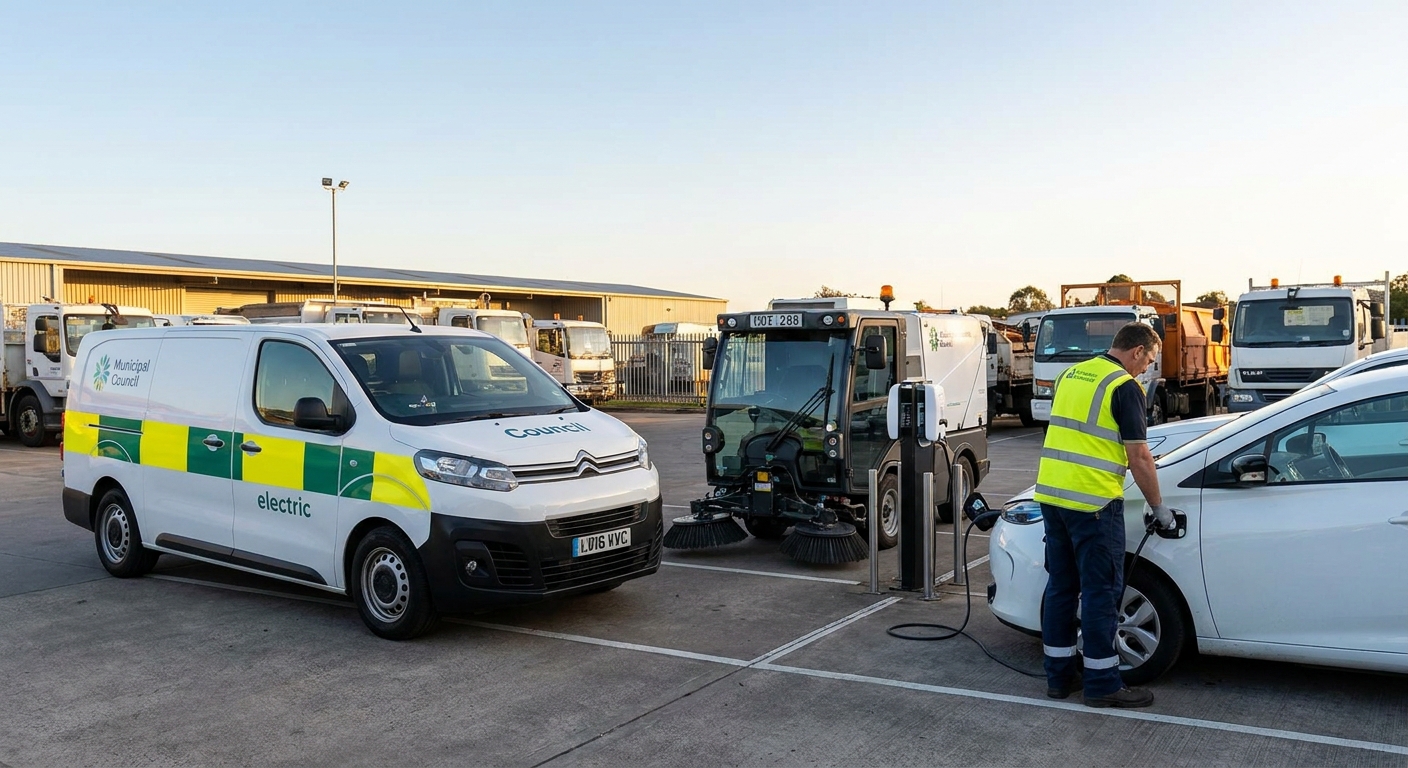
Councils across the UK are under pressure to electrify light-duty fleets ahead of 2030 phase-out dates for new petrol and diesel vehicles, and the transition succeeds or stalls on data, not good intentions. This guide walks through the practical steps to move a council fleet onto electric vehicles without breaking budgets or leaving depots without working vehicles.
- Transitioning a council fleet to electric vehicles in 2026 starts with mileage and duty-cycle data, not vehicle orders.
- Mixed EV and diesel fleets need telematics that reports charge state and fuel level separately — treat them as one dataset, not two fleets.
- Most local authorities phase EVs in over 3-5 years, starting with pool cars and short-route vans before HGVs.
- Depot charging infrastructure typically costs more to plan than the vehicles themselves — budget for it first.
Why this matters
Many UK local authorities have set net zero targets for 2030 or 2035, and fleet emissions are one of the few line items a council can act on directly rather than lobby for. Fuel duty, maintenance costs on ageing diesel vans, and Clean Air Zone charges in cities like Birmingham and Bristol all push the same direction.
The operational risk isn't the vehicles — it's the data gap. A council running 40 diesel vans and 12 electric pool cars needs one system that tells a fleet manager which vehicle is low on charge, which is low on fuel, and which route just got assigned to a van that can't make it back to depot. Get that wrong once during a bin collection round or a social care visit and the transition becomes a political problem, not a technical one.
What you'll need
- Twelve months of trip and mileage data per vehicle, ideally from an existing GPS fleet tracking for local council fleets system
- A charging infrastructure plan covering depot chargers and any on-street or destination charging
- A capital and revenue business case, including any available grant funding
- A telematics platform that reports EV state-of-charge alongside diesel fuel data
- A driver training plan covering regenerative braking, charging etiquette, and range planning
- A pilot group of 5-15 vehicles to test before fleet-wide rollout
The steps
1. Audit your existing fleet and journey data
Pull twelve months of mileage, idle time, and route data for every vehicle before you order a single EV. This tells you which routes are genuinely short enough for current battery ranges and which aren't — guessing here is the single most common reason council EV pilots underperform in year one.
Run the audit by depot and by vehicle class separately. A refuse vehicle and a parking enforcement car have completely different duty cycles, and lumping them together in one spreadsheet hides the routes that will fail on range.
Common mistake: auditing average daily mileage instead of worst-case daily mileage. A van that averages 38 miles a day but occasionally covers 95 will strand an EV with a 100-mile real-world range on a cold January morning.
2. Map daily mileage against EV range for each route
Cross-reference the audit against realistic EV range, not manufacturer-claimed range — expect 15-25% degradation in cold weather and with HVAC running, which matters for a UK winter. Flag every vehicle whose worst-case day exceeds 70% of realistic range as not yet ready for a straight EV swap.
This step produces your phasing order: short-route pool cars and town-centre vans go first, rural refuse routes and HGVs go last, often years later once range and charging infrastructure catch up.
3. Build the business case and secure funding
Model total cost of ownership over 5-7 years, not the sticker price of the vehicle. Include reduced fuel and maintenance costs, any Clean Air Zone charge avoidance, and available government grant schemes for depot charging infrastructure.
Use how to calculate ROI on fleet management software as the framework — the same telematics data that flags idle time and fuel waste on diesel vehicles is what proves the payback period to finance committees on EVs.
Common mistake: presenting the business case as an environmental initiative alone. Finance and procurement committees respond to pounds saved per vehicle per year, not carbon narratives.
4. Plan charging infrastructure before ordering vehicles
Depot charging capacity is usually the real bottleneck, not vehicle supply. A depot with 15 EVs charging overnight needs a grid connection upgrade in most cases, and that application can take longer than the vehicle lead time itself in 2026.
Sequence chargers to match your phasing order from step 2 — don't install capacity for the full fleet on day one if only 12 vehicles convert in year one. Oversized infrastructure sits idle and underfunded infrastructure causes queuing at shift change.
Expected outcome: a phased charger installation plan tied directly to your vehicle rollout schedule, not a single big-bang infrastructure spend.
5. Pilot with a small, low-risk vehicle segment
Start with 5-15 vehicles on the shortest, most predictable routes — pool cars and parking enforcement vehicles are common first movers for councils. Run the pilot for a full quarter, including at least one cold-weather month, before scaling.
This is where range anxiety turns into confidence or gets exposed early, while the exposure is limited to a handful of vehicles rather than the whole fleet.
6. Deploy telematics to monitor the mixed fleet as one system
Once EVs join diesel vehicles on the same rota, a fleet manager needs one dashboard, not two. Managing a mixed EV and diesel fleet with telematics covers how to configure alerts for state-of-charge alongside fuel level so dispatch doesn't assign a low-charge EV to the longest route of the day by accident.
Common mistake: running EV charge monitoring through the vehicle manufacturer's own app and diesel fuel monitoring through telematics separately. That split is exactly how vehicles get double-booked or sent out under-charged.
7. Train drivers and depot staff on the new routine
EV driving habits differ enough from diesel that skipped training shows up in higher energy consumption and more depot charging conflicts. Cover regenerative braking technique, plugging in at end of shift as standard practice, and how to read range on the dash versus the telematics platform.
Build this into your existing onboarding process — how to onboard drivers onto a new fleet tracking system applies directly here, since drivers are learning a new vehicle type and a new monitoring system at the same time.
8. Scale the rollout fleet-wide
Expand from the pilot cohort in phases of 15-25 vehicles, reviewing telematics data after each phase before ordering the next batch. Councils that scale in one large procurement round lose the ability to correct route assignments or charging schedules that the pilot data got wrong.

Troubleshooting
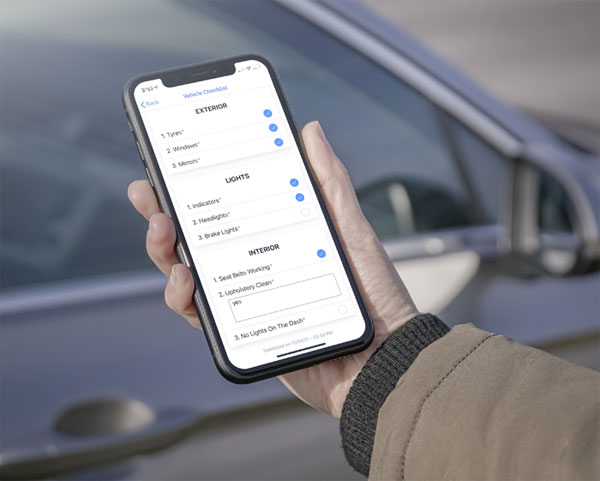
Drivers report range anxiety even on short routes. Show them the telematics range data in the cab, not just the manufacturer dash estimate — real trip history builds trust faster than a spec sheet.
Depot chargers queue at shift change. Stagger shift start times by 15-20 minutes across vehicle groups, or add off-peak overnight charging windows tied to telematics-reported return times.
Budget overruns on charging infrastructure. This almost always traces back to sizing chargers for the full fleet instead of the current phase — rebuild the infrastructure plan against the phased rollout from step 4.
Grant applications delay vehicle delivery. Apply for infrastructure grants at the same time as the business case in step 3, not after vehicle orders are placed — the lead times rarely align otherwise.
Diesel vehicles skew utilisation data. Segment reporting by vehicle class in your telematics platform so an ageing diesel HGV's worst-case mileage doesn't get averaged into the EV-suitable van fleet's figures.
Fleet manager loses visibility once EVs join the diesel fleet. This is the most common failure point in 2026 rollouts — a single mixed-fleet telematics dashboard, not two separate systems, is the fix.
Tools and resources
- GPS fleet tracking for local council fleets for the baseline mileage audit
- Best fleet tracking software for local government fleets for comparing platforms before you commit
- How to manage a mixed EV and diesel fleet with telematics for the ongoing operational setup
- How to calculate ROI on fleet management software for the business case in step 3
What to do next
Once the pilot phase is running, the next bottleneck is usually driver adoption, not the vehicles. How to onboard drivers onto a new fleet tracking system covers the rollout sequence that keeps drivers using the system correctly instead of reverting to old habits.
FAQ
What's the best way to transition a council fleet to electric vehicles?
Start with a full mileage and duty-cycle audit, then phase in EVs on the shortest, most predictable routes first. Councils that order vehicles before auditing routes end up with EVs stranded on routes that exceed realistic range.
How long does an EV fleet transition take for a local authority?
Most councils phase the transition over 3-5 years, starting with pool cars and light vans before moving to HGVs and specialist vehicles. The timeline depends more on depot charging infrastructure than vehicle availability.
Can telematics track EV charge state and diesel fuel level together?
Yes, a mixed-fleet telematics platform reports state-of-charge and fuel level on the same dashboard. Running separate systems for EVs and diesel vehicles is the most common cause of misassigned routes.
Is it cheaper to run a mixed EV and diesel fleet than an all-diesel fleet?
Fuel and maintenance costs typically drop per EV mile compared to diesel, but the transition period adds depot infrastructure and training costs. The full business case needs a 5-7 year total cost of ownership model, not a per-vehicle price comparison.
Do councils need separate depots for EV charging?
No, most councils add charging infrastructure to existing depots rather than building new ones. Grid connection capacity, not depot space, is usually the limiting factor.
How much does it cost to convert a council fleet to EV in 2026?
Costs vary by fleet size and vehicle class, and depot charging infrastructure often costs as much as the vehicle order itself. Government grant schemes can offset a portion of the infrastructure spend.
What vehicles should councils electrify first?
Pool cars, parking enforcement vehicles, and short-route vans convert first because their daily mileage sits comfortably within realistic EV range. HGVs and rural refuse routes typically convert last.
How do you monitor driver behaviour on electric vehicles?
Driver behaviour monitoring on EVs tracks braking style, acceleration, and regenerative braking use, which directly affects energy consumption per mile. The same telematics data used for diesel driver scoring applies to EVs with EV-specific thresholds.
One last thing
The councils that get this right in 2026 treat the charging infrastructure plan as the critical path, not the vehicle order — depot grid capacity applications routinely take longer than the vehicle lead time, and starting that application after the vehicles are ordered is the single most common cause of stalled rollouts.